
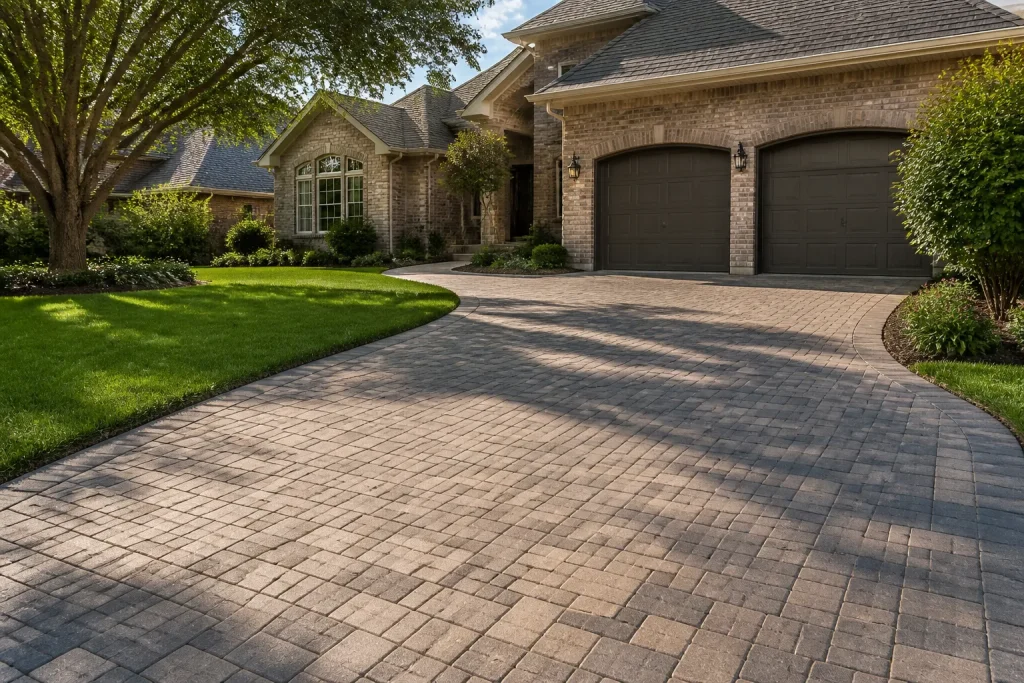
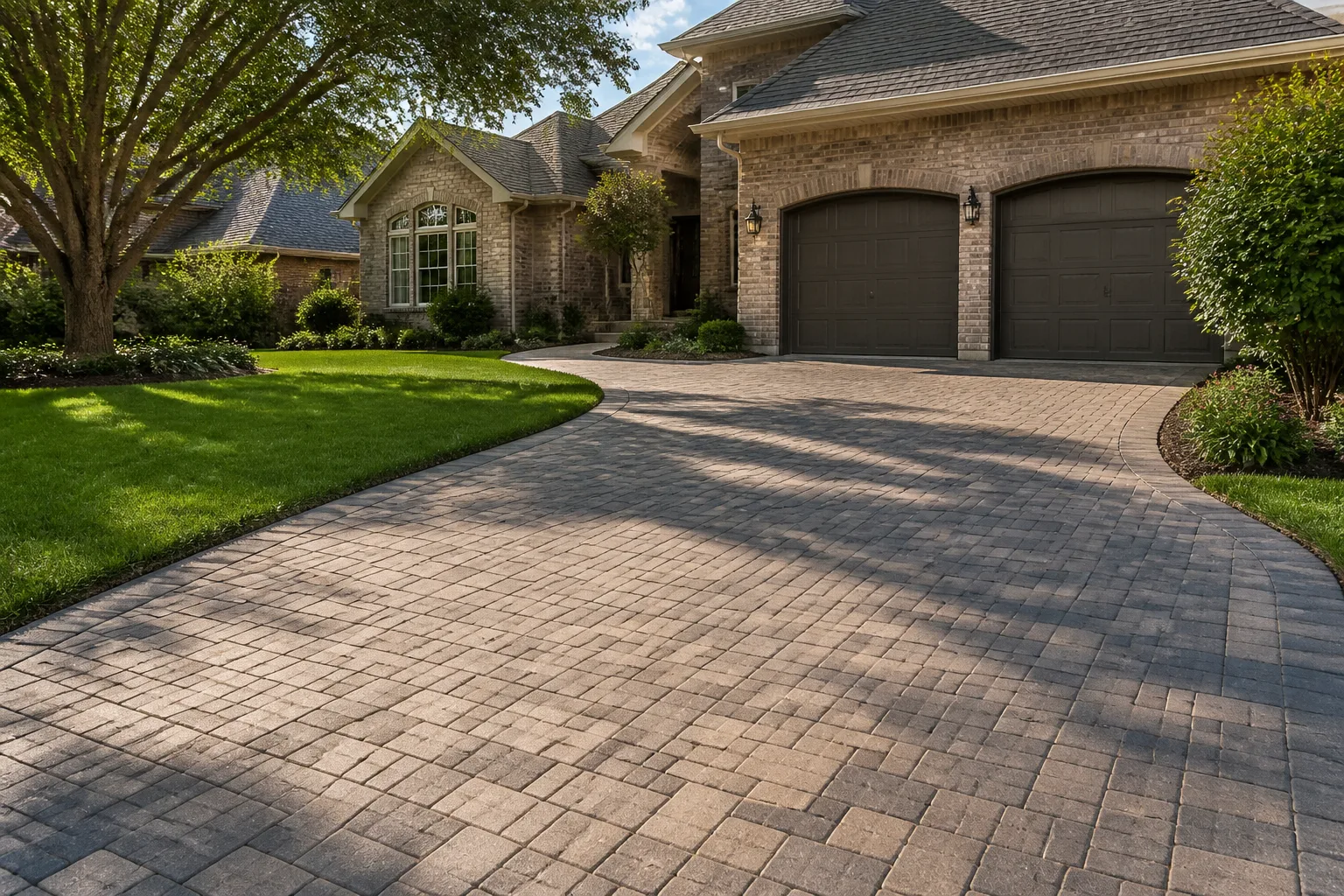
Schluter Driveway & Pavers in Garland: A Homeowner’s Guide
Schluter Systems is best known for tile edge trim, but the company also makes substrate and transition products that solve one of the most overlooked problems in a Garland driveway: managing the edge where pavers meet garage slabs, sidewalks, and landscaping borders so that junction doesn’t crack, settle, or heave. The place where your driveway pavers meet your garage slab is the single most likely failure point in the entire installation, and it’s the detail most bids don’t even mention. If you’d rather not sort through profiles and membranes on your own, call (888) 405-7616 and we’ll talk it through.
Why Does the Paver-to-Garage-Slab Edge Fail in Garland?
That junction fails because it’s where two different materials, moving at different rates, are forced to meet. In Garland, the soils under a driveway are often shrink-swell clay types that expand when wet and contract when dry, and that seasonal movement is exactly what opens up the seam between a paver field and a rigid concrete slab. When a crew simply butts pavers against the slab with a bead of caulk or a line of sand, that joint has nowhere to move. The result is a hairline crack that widens, loose edge pavers, and a spot where water gets in and stays.
A transition profile gives that edge a controlled place to flex. Instead of a hard, brittle connection, the pavers and the slab meet through a moving joint that absorbs the soil movement rather than fighting it. That’s the whole reason the detail matters so much in the Garland area. A driveway built somewhere with stable, sandy soils can sometimes get away with a simple butt joint. A driveway built on clay cannot.
What you’ll typically see when a transition edge is done right:
- A defined gap between the paver field and the concrete, filled with a flexible, compressible material rather than sand or caulk alone.
- An edge restraint that holds the pavers against lateral spread.
- A junction that stays flush, so the transition to the garage floor or walkway is smooth and doesn’t become a trip hazard.
What Do Schluter’s Edge and Transition Profiles Actually Do?
Schluter edge and transition profiles do two jobs at a paver-to-concrete junction: they protect the vulnerable edge of the pavers from chipping and spalling, and they create a joint that accommodates movement between the paving and the adjoining hard surface. Where a plain edge slowly crumbles under foot traffic and mower wheels, a profile carries that load and holds the line clean.
The other half of the job is waterproofing and moisture management. Water that gets behind the edge of a paver field and sits against a slab can work its way under, softening the base and feeding the very movement you’re trying to control. Schluter’s exterior-rated profiles, together with their waterproofing products, route that water where it can drain instead of where it can pool. This is the part of the installation nobody photographs and everybody notices later, when the edge has sunk.
It helps to understand the difference between the products at a glance:
- Edge protection profiles shield the paver’s finished edge and give the junction a clean, straight line.
- Transition profiles manage the meeting point between two different surfaces, whether that’s pavers-to-concrete or a paver field meeting a different height.
- Waterproofing and uncoupling membranes handle what’s happening underneath, separating the paving from the substrate so movement in one doesn’t telegraph straight into the other.
Does DITRA Belong on a Paver Driveway Over Concrete?
Schluter DITRA and similar uncoupling membranes can be part of a paver-over-concrete installation, but only in specific cases, and this is where a lot of bids go wrong in both directions. The membrane’s job is to uncouple the finish surface from the substrate so that small movements in the concrete slab don’t crack through into what sits on top. That matters when you’re laying pavers directly over an existing, structurally sound concrete driveway and you want to control how the slab’s movement affects the paver bed. It is not a fix for a slab that’s cracked, heaved, or draining toward the house.
In our experience, the honest answer to “can we use DITRA here?” is that it depends on what the slab is doing. If the existing concrete in Garland is intact and flat and draining correctly, an uncoupling layer can make a paver-over-concrete installation more predictable over time. If the slab has real structural problems, no membrane fixes that. You repair the concrete first or you tear it out. A crew that proposes a membrane without looking hard at the slab is skipping the step that actually determines whether the driveway lasts.
This is also where the exterior rating matters. Products designed for interior tile can’t simply be carried outdoors; the correct exterior-rated assemblies are the ones that are meant to live under weather and traffic. Ask specifically which product is rated for exterior use, and why that one was chosen for your driveway in Garland.
Which Schluter Products Fit an Exterior Hardscape Job?
The products that actually belong on the outside of a house are the ones designed for exterior conditions: edge and transition profiles rated for outdoor use, waterproofing assemblies that tolerate weather, and drainage and uncoupling components built for the loads a driveway takes. Interior trim is trim; it doesn’t belong under a car.
Where these products get specified correctly is at the junctions, not across the whole field. The paver field itself is standard driveway construction. The profiles go at the places where that field meets something else: the garage slab, a concrete walkway, a landscape border, a step-down to a lower grade. On a typical job, that’s a handful of linear feet doing most of the structural work.
For exterior hardscape in Garland, it helps to think of the specification in layers:
- Edge restraint along the outer boundary, holding the pavers from spreading.
- Transition profiles at every hard junction, garage slab and walkway included.
- Waterproofing and drainage at the edges, so water moves away rather than soaking in.
- Uncoupling membrane only where a slab-over installation justifies it.
When you’re building a full exterior scope at once, this is the kind of detail that gets easier to control. A new driveway, a new walkway, and a reworked entry read as one project when the transitions are planned together. When the same homeowner is also considering a garage conversion or a detached structure, our home additions & ADU work often overlaps with the same exterior hardscape planning, and prefab pathways from makers like Abodu, Dvele, and Mighty Buildings can influence where a driveway needs to connect and how the grades run.
A Typical Scenario: Pavers, a Stamped Concrete Walkway, and a Garage Floor
Picture a common Garland setup: a driveway resurfaced in pavers, meeting a stamped concrete walkway at the front and the garage floor at the back. Three different materials, three different ways of moving, all within a few feet of each other. That’s the situation where transition profiles earn their place.
At the garage slab, the paver field needs a moving joint and an edge profile so the pavers don’t crack against the rigid slab and the transition to the garage floor stays flush. At the stamped walkway, the meeting point between pavers and stamped concrete needs a transition that keeps the two surfaces level and hides the material change in a clean line. And along the landscape border, the edge needs restraint so the pavers stay put as the soil moves. Each junction is small. Together they determine whether the driveway still looks tight in a few years or has started to unravel at every seam.
This is also why a bid that lumps “driveway install” into one line item tells you almost nothing. The materials and the field work are the visible part. The transitions are where the craft lives. We’ve seen plenty of driveways where the pavers themselves were fine and the edges were the problem.
What to Ask Any Contractor About Transition Zones
Ask any contractor how they’ll handle each junction specifically, and listen for whether the answer is concrete or vague. A vague answer (“we’ll seal it,” “we always take care of the edges”) usually signals a crew that hasn’t thought about how that edge will move with the soil. A specific answer names the profile, the joint, the drainage, and the reason.
Questions worth asking before you sign anything:
- How will you treat the joint between the pavers and my garage slab, and what’s the moving element?
- Which products are you using at each transition, and are they rated for exterior use?
- How do you handle drainage at the edges so water doesn’t sit against the slab?
- If the existing concrete has cracks or heaves, what’s the plan before any pavers go down?
- How do you keep the transition to my walkway and garage floor flush so it isn’t a trip hazard?
If the crew can’t tell you the difference between an edge restraint and a transition profile, or why exterior-rated matters, that’s your sign. Our technicians have up to 10 years of experience with hardscape work, and in our experience the crews that get this right are the ones who can explain it before they start. You choose the material; we bring the expertise on how it goes together.
When to call a pro: if your existing driveway edge is already cracked, loose, or pooling water at the garage, the fix is more than cosmetic, and it’s worth getting eyes on it before it gets worse.
Related services in Garland: our driveway & pavers work is where these transition details most often come up, and many homeowners pair a driveway refresh with new fence installation to finish the property edge at the same time.
How Much Does This Kind of Driveway Work Cost in Garland?
Prices for paver driveways and the transition detailing around them vary widely by size, material, and what’s underneath. We don’t quote exact numbers here because the written estimate sets the final price, and a range you read online is only a starting point. What we can tell you is what drives the cost up or down: the square footage, whether an old surface has to come out, the condition of the existing slab, how many transitions the layout involves, and the paver line you choose from manufacturers like Belgard, Unilock, Techo-Bloc, and Cambridge Pavers.
The transition profiles and membranes are a small share of the total budget, but they’re the part that decides whether the driveway holds up. Skipping them to save a little on the front end usually costs more later, once the edge has failed. Ask for a written, line-item estimate so you can see what’s being specified at each junction, not just a lump sum.
The Bottom Line
Schluter products earn their place on a Garland driveway at the edges: the meeting points between pavers and garage slabs, walkways, and landscape borders. In clay soil that moves with the seasons, a controlled, flexible transition is what keeps those junctions from cracking and settling. The paver field is the visible part; the details at the edges are what make it last.
Construction Garland brings driveway and paver work together with the rest of the home under one contractor, from driveway to roofline, with access to leading hardscape and building brands so you choose the material and we handle how it’s put together. From curb to kitchen, the goal is one accountable team instead of a scramble of specialty bids.
If you’re in Garland and need help, Construction Garland offers free estimates. Call (888) 405-7616. We answer 24/7. Fast dispatch from 7am to 7pm, Sunday through Friday.
Frequently Asked Questions
You need proper transition detailing at every hard junction; Schluter’s exterior-rated profiles are one well-made way to provide it. The paver field itself doesn’t need profiles across the whole surface. The edges where pavers meet concrete are the spots that need a moving joint and edge protection, especially in Garland’s shrink-swell soils. Call (888) 405-7616 for a free estimate on your specific layout.
Only in the right application: a paver-over-concrete installation on an existing slab that’s structurally sound, flat, and draining correctly, using the exterior-rated assembly. It is not a fix for a cracked or heaved slab. The slab’s condition decides whether an uncoupling membrane makes sense at all.
It cracks because the pavers and the slab move at different rates and the seam has nowhere to give. Soil movement under a Garland driveway pushes and pulls, and a rigid butt joint with sand or caulk can’t absorb it. A transition profile with a compressible joint lets the edge flex instead of fracture.
Ask them to name the product, the joint, and the drainage plan at each junction. A crew that can explain why exterior-rated profiles matter and how they’ll keep the garage and walkway transitions flush understands the work. Vague answers about “sealing it” usually mean the detail wasn’t planned. Call (888) 405-7616 to schedule your free estimate and we’ll walk you through it.
Written by the team at Construction Garland.
Need Construction Help?
Call Construction Garland - licensed & insured, with free written estimates in Garland.
(888) 405-7616